BestCalcHub
BestCalcHub
Online calculators
Engineering8 min read

How Pipe Diameter Affects Pump Flow Rate

Learn how pipe diameter affects pump flow rate, flow area, velocity, friction losses, pump head, and the real operating point of a pumping system.

By MuneebPublished 2026-08-12Updated 2026-08-12
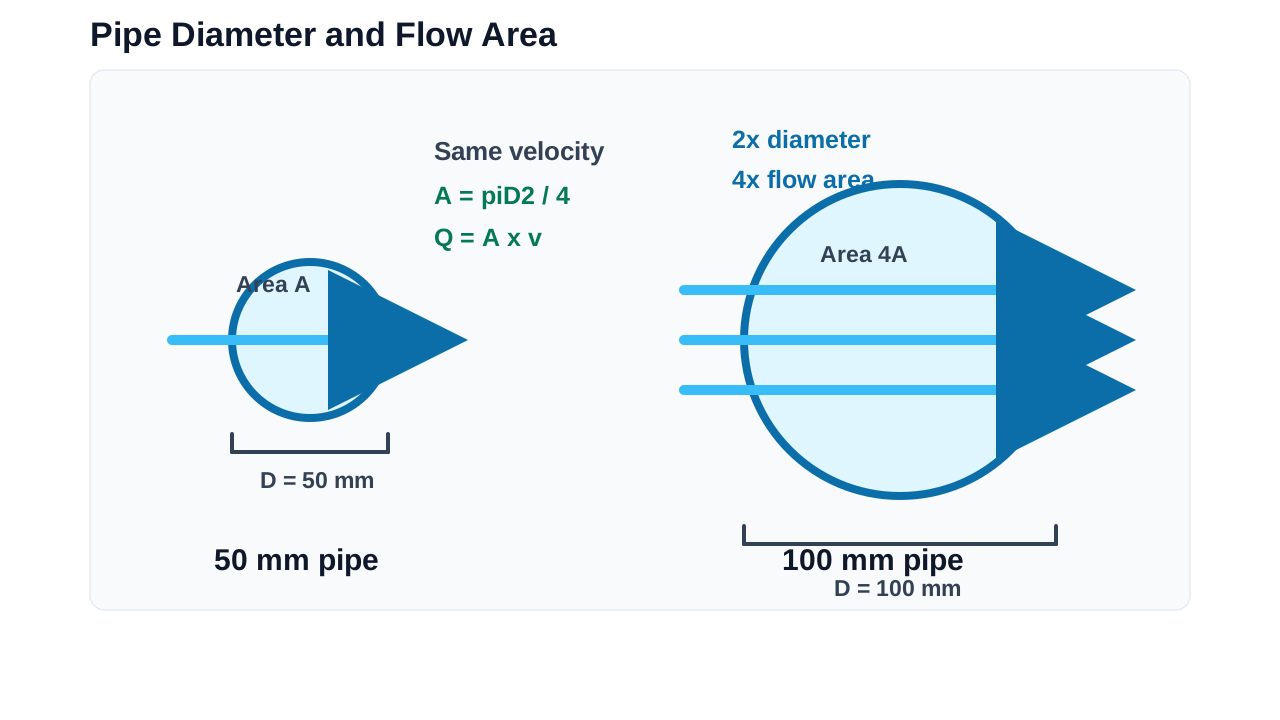
Comparison of pipe diameter and cross-sectional area at the same fluid velocity
At the same velocity, flow capacity increases with the square of internal pipe diameter.

Pipe diameter has a major influence on how fluid moves through a pumping system. A change in pipe diameter affects flow area, velocity, friction losses, and the operating conditions of the pump.

For a given fluid velocity, increasing pipe diameter allows a greater volumetric flow rate because the available flow area becomes larger. Real systems are more complicated because changing pipe diameter also changes velocity and system resistance.

Understanding this relationship is important when designing or evaluating a pump and piping system.
Why Pipe Diameter Matters

A circular pipe provides a cross-sectional area through which the fluid flows.

As diameter increases, the available flow area increases with the square of the diameter.

This is the key reason pipe diameter has such a strong effect on theoretical flow capacity.

For flow calculations, D should be the actual internal pipe diameter, not only the nominal pipe size.

Formula

A = piD2 / 4

  • A = pipe cross-sectional area
  • D = internal pipe diameter

How Diameter Affects Flow at the Same Velocity

For a given fluid velocity, volumetric flow rate is related to area by Q = A x v.

Combining area and velocity means that, at the same velocity, flow rate is proportional to the square of pipe diameter.

If pipe diameter is doubled while velocity remains unchanged, the theoretical flow capacity becomes four times larger.

This mathematical relationship is important, but it does not mean that installing a pipe with twice the diameter will automatically produce four times the real pump flow in an existing system.

Formula

Q = A x v = (piD2 / 4) x v

What Happens When Pipe Diameter Doubles?

Comparison of pipe diameter and cross-sectional area at the same fluid velocity
A 100 mm pipe has four times the flow area of a 50 mm pipe.

Consider two circular pipes carrying fluid at the same velocity. Pipe A has a 50 mm diameter and Pipe B has a 100 mm diameter.

The second pipe has twice the diameter. Because area depends on diameter squared, the area ratio is (100 / 50)2, or 4.

Therefore, at the same velocity, the 100 mm pipe can theoretically carry four times the volumetric flow of the 50 mm pipe.

This is why relatively small changes in pipe diameter can produce large differences in theoretical flow capacity.

Pipe Diameter and Fluid Velocity

Pipe diameter also affects fluid velocity.

For a fixed flow rate, increasing the pipe diameter increases the cross-sectional area. As area increases, velocity decreases.

If the required flow remains constant and the pipe diameter increases, the same amount of fluid is distributed across a larger area.

That reduction in velocity can influence friction losses, noise, erosion, and energy consumption.

Formula

v = Q / A

Why Lower Velocity Can Matter

High velocity can increase hydraulic losses and may create practical problems depending on the fluid and system.

Potential effects include higher friction losses, greater pressure drop, increased noise, higher erosion risk, and greater pumping energy requirements.

A larger pipe can reduce velocity at the same flow rate. However, larger pipe also increases material cost, installation cost, and sometimes equipment requirements.

The goal is not simply to choose the largest possible pipe. The goal is to select a diameter appropriate for the required flow and application.

  • Higher friction losses
  • Greater pressure drop
  • Increased noise
  • Higher erosion risk
  • Higher pumping energy

Pipe Diameter and Friction Loss

Pipe diameter has a major influence on friction loss.

For a given flow rate, a smaller pipe generally produces higher fluid velocity. Higher velocity generally means greater friction losses.

As friction losses increase, the pumping system may require more head to maintain the desired flow.

This creates a practical chain: pipe diameter changes velocity, velocity changes friction loss, and friction loss changes required pump head.

What Happens to Pump Flow When Pipe Diameter Changes?

The result depends on whether velocity is fixed, flow is fixed, or an existing pump and system are being modified.

If velocity is held constant, increasing pipe diameter increases theoretical flow according to Q = A x v.

If required flow remains fixed, increasing pipe diameter reduces velocity and can reduce friction losses.

If pipe diameter changes in an existing system, the pump curve stays related to the pump while system resistance changes. The actual flow may therefore change depending on the new operating point.

Pipe Diameter and Pump Head

A smaller pipe can increase system resistance at a given flow. This can increase the head that the pump needs to provide.

A larger pipe can reduce friction losses and lower the required system head.

When system head decreases, the pump may be able to operate at a higher flow rate along its performance curve.

The final effect depends on the complete system, not pipe diameter alone.

Pipe Diameter and Pump Operating Point

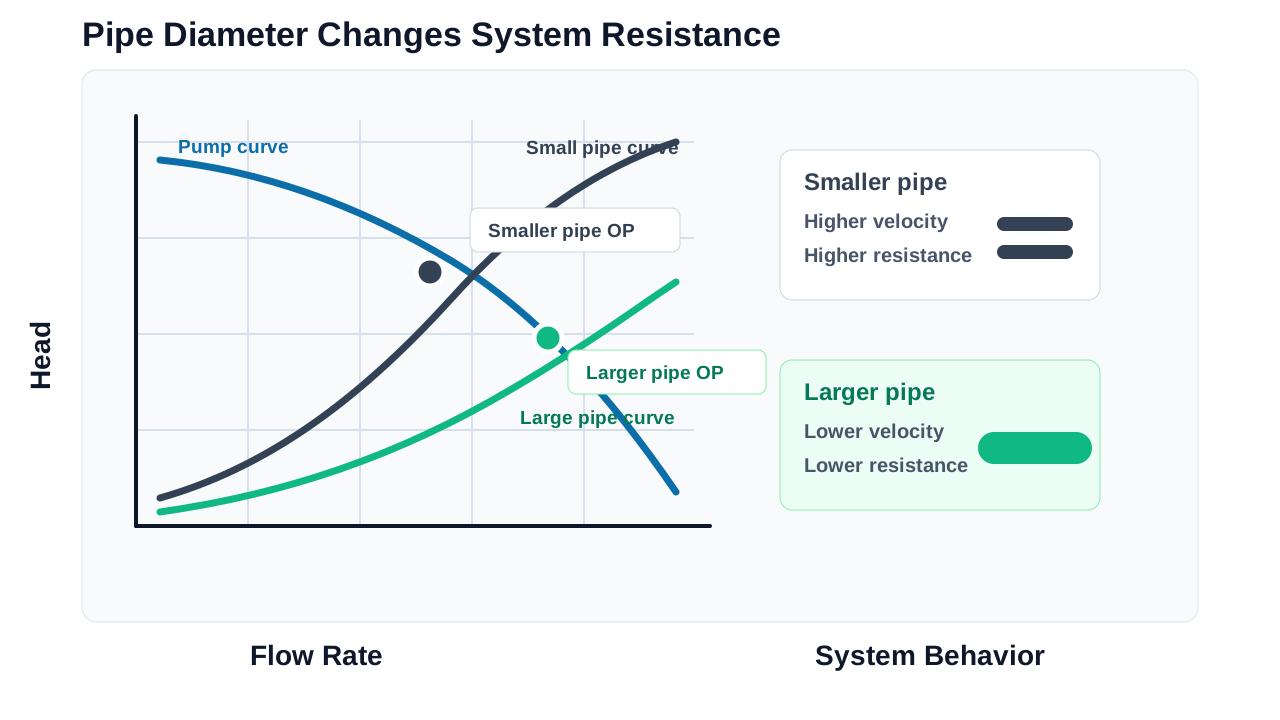
Effect of pipe diameter on system resistance and pump operating point
Changing pipe diameter changes system resistance, which can move the pump operating point.

A useful way to understand the relationship is through the pump and system curves.

When pipe diameter changes, system resistance changes, the system curve changes, and the intersection with the pump curve can move.

A larger pipe generally reduces friction-related resistance. A smaller pipe generally increases it.

The resulting operating point determines the actual flow and head delivered by the system.

Related guide - Pump Flow Rate vs Pump Head

Internal Diameter vs Nominal Pipe Size

One common mistake is assuming the nominal pipe size is the same as the actual internal diameter.

Actual internal diameter can vary depending on pipe schedule, wall thickness, material, standard, and manufacturing specification.

For a flow calculation, the relevant value is the actual internal diameter.

Using nominal diameter without checking the actual internal bore can introduce errors into velocity and flow calculations.

Example of Diameter and Flow

Suppose water flows through a circular pipe at 2 m/s and the internal diameter is 50 mm, or 0.05 m.

The area is approximately 0.00196 m2, so the flow is approximately 0.00392 m3/s. This equals about 3.92 L/s, or 235 L/min.

Now consider a 100 mm pipe at the same velocity. The area is approximately 0.00785 m2 and the flow is approximately 0.0157 m3/s, or 15.7 L/s.

This is approximately four times the flow of the 50 mm pipe because diameter doubled while velocity stayed constant.

Why Real Systems Do Not Always Follow the Four-Times Rule

The four-times relationship applies when velocity remains constant.

In a real pump system, velocity often changes because flow changes. Changing pipe diameter also changes system resistance, which changes the operating point of the pump.

Doubling pipe diameter does not automatically mean the real pump flow will quadruple.

The actual result depends on the pump curve, system curve, flow requirement, pipe length, pipe roughness, fittings, valves, fluid properties, and pump speed.

Choosing Pipe Diameter for a Pumping System

Pipe diameter should be selected by considering the entire system.

Important factors include required flow, acceptable velocity, pressure loss, pump head, installation cost, and operating cost.

Larger pipes generally cost more to purchase and install, while smaller pipes can increase pressure losses and pumping energy.

Good pipe sizing balances these factors rather than optimizing only one of them.

  • Required flow
  • Acceptable velocity
  • Pressure loss
  • Pump head
  • Installation cost
  • Operating cost

Common Pipe Diameter and Flow Mistakes

  • Using nominal diameter instead of actual internal diameter
  • Assuming bigger pipe always means more pump flow
  • Ignoring velocity
  • Ignoring friction losses
  • Using the four-times rule without its conditions
  • Selecting pipe size from flow alone