BestCalcHub
BestCalcHub
Online calculators
Engineering7 min read

GPM vs LPM Pump Flow Rate Conversion Guide

Convert pump flow rate between GPM, LPM, m3/h, and L/s with practical formulas, examples, and pump selection context.

By MuneebPublished 2026-08-12Updated 2026-08-12
Pump flow rate conversion between GPM LPM and cubic meters per hour
Common pump flow units can be converted through LPM as a practical reference unit.

Pump flow rate can be expressed using several different units depending on the country, industry, pump manufacturer, and project specification.

Two of the most common units are GPM, or gallons per minute, and LPM, or liters per minute. Engineers may also encounter m3/h and L/s when working with metric systems.

Understanding these conversions is important when reading pump datasheets, comparing equipment, checking project specifications, or converting calculations between measurement systems.
What Is GPM?

GPM stands for gallons per minute.

It is commonly used in the United States and appears frequently on pump specifications, irrigation equipment, water systems, and industrial pump data.

GPM tells you how many US gallons of fluid pass through a system in one minute.

For example, 50 GPM means the system is delivering 50 US gallons per minute under the specified operating conditions.

What Is LPM?

LPM stands for liters per minute.

It is commonly used in metric engineering applications.

For example, 100 LPM means the system is delivering 100 liters of fluid every minute.

Because one liter is much smaller than one US gallon, the numerical value in LPM is normally larger than the equivalent value in GPM.

GPM to LPM Conversion

For US gallons, 1 GPM is approximately 3.78541 LPM.

If the pump flow is 50 GPM, the converted flow is 50 x 3.78541, or 189.27 LPM.

For practical calculations, this may be rounded to about 189 LPM.

Formula

LPM = GPM x 3.78541

LPM to GPM Conversion

To convert LPM to US GPM, use 1 LPM equals approximately 0.264172 GPM.

If the flow rate is 200 LPM, the converted value is 200 x 0.264172, or 52.83 GPM.

This means 200 LPM is approximately 52.8 GPM.

Formula

GPM = LPM x 0.264172

GPM and LPM Quick Conversion Table

Pump flow rate conversion reference for GPM LPM m3 per hour and L per second
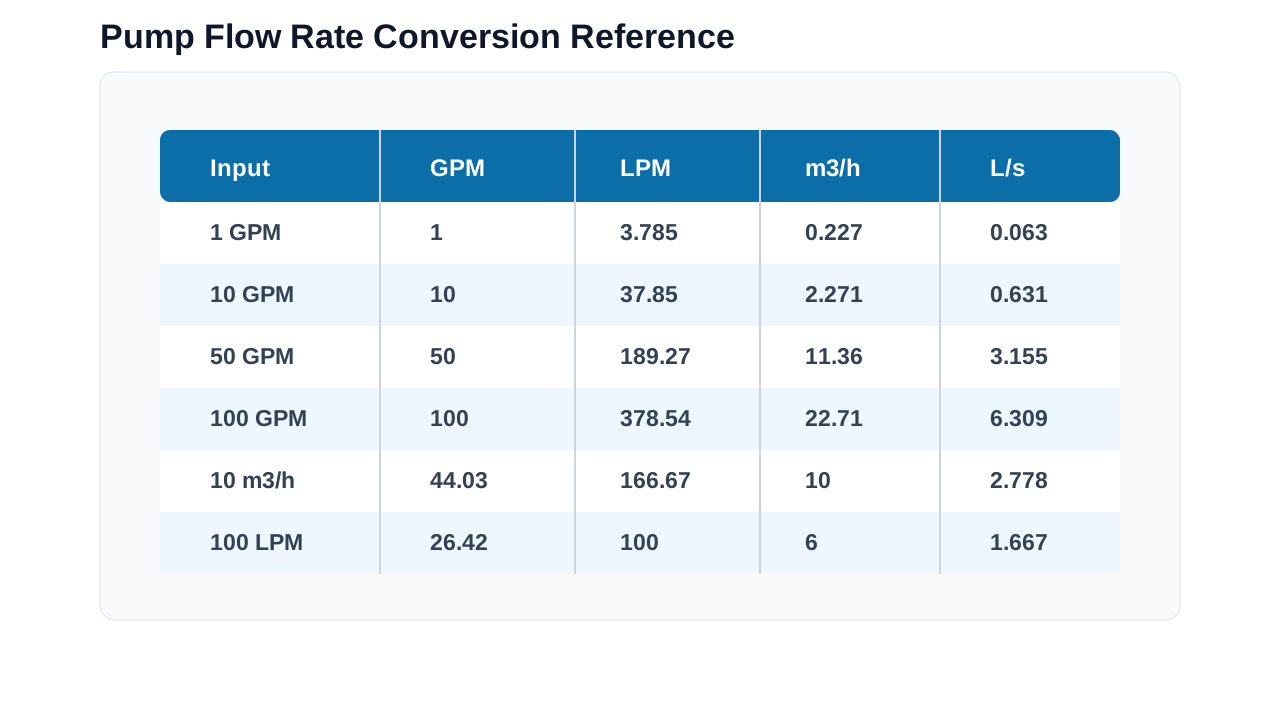
A compact reference for common pump flow conversions.

Common values are useful when comparing pump datasheets or checking project specifications.

For US gallons, 1 GPM is about 3.79 LPM, 10 GPM is about 37.85 LPM, 50 GPM is about 189.27 LPM, and 100 GPM is about 378.54 LPM.

These values use the US gallon. Imperial gallons use a different conversion factor.

What Is m3 per Hour?

m3/h means cubic meters per hour.

It is widely used in industrial, process, HVAC, water treatment, and other metric engineering applications.

One cubic meter contains 1,000 liters. Since one hour contains 60 minutes, 1 m3/h is approximately 16.67 LPM.

Formula

1 m3/h = 16.6667 LPM

Convert m3 per Hour and LPM

To convert m3/h to LPM, multiply by 16.6667.

For example, 12 m3/h is approximately 200 LPM.

To convert LPM to m3/h, divide LPM by 16.6667. For example, 500 LPM is approximately 30 m3/h.

Formula

LPM = m3/h x 16.6667

Convert GPM and m3 per Hour

Combining common conversion factors gives 1 GPM as approximately 0.227125 m3/h.

For 100 GPM, the approximate flow is 22.71 m3/h.

The reverse relationship is 1 m3/h equals approximately 4.40287 GPM. For 10 m3/h, the equivalent flow is about 44.03 GPM.

Formula

m3/h = GPM x 0.227125

Flow Unit Relationships

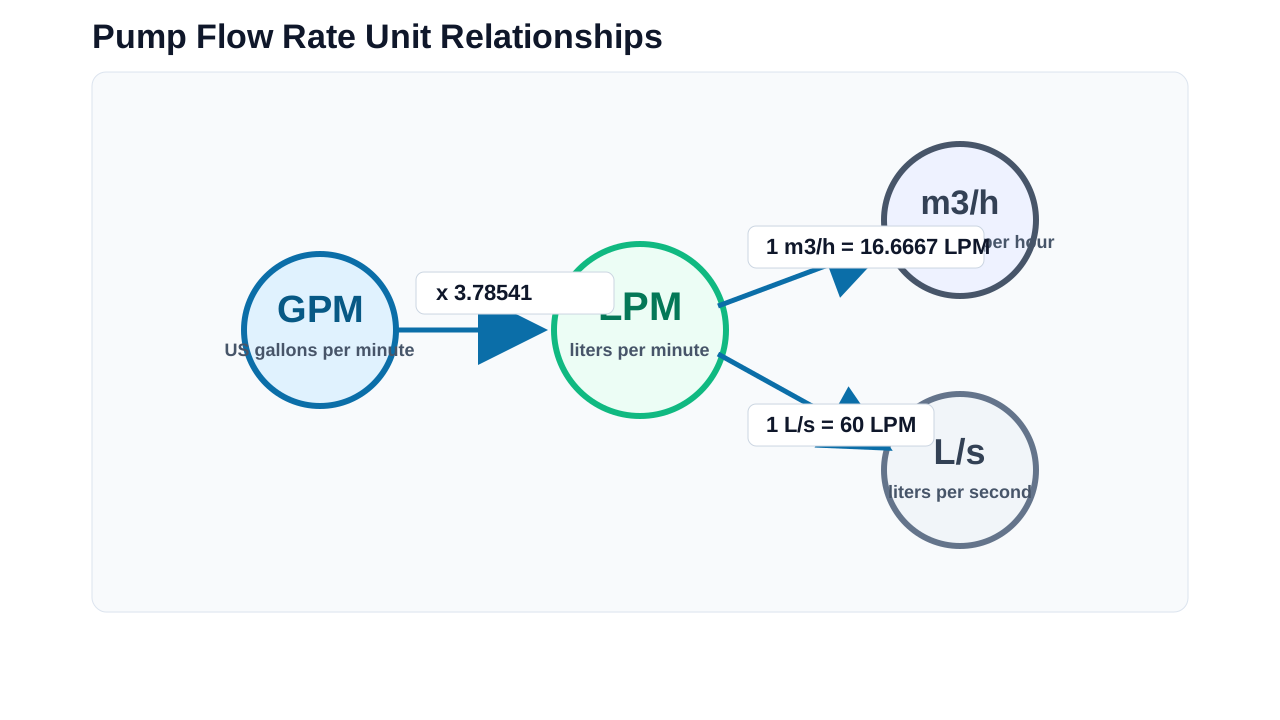
Pump flow rate conversion between GPM LPM and cubic meters per hour
GPM, LPM, m3/h, and L/s are different ways of expressing the same flow quantity.

The most common pump flow units can be connected through a few practical relationships.

1 GPM is approximately 3.78541 LPM. 1 m3/h is approximately 16.6667 LPM. 1 L/s equals 60 LPM.

Keeping these relationships available makes pump datasheet comparisons and engineering calculations easier.

What Is L per Second?

L/s means liters per second.

It is another metric unit used in fluid engineering.

To convert L/s to LPM, multiply by 60. To convert LPM to L/s, divide by 60.

For example, 5 L/s equals 300 LPM.

Formula

1 L/s = 60 LPM

GPM to L per Second

Because 1 GPM is approximately 3.78541 LPM and 60 LPM equals 1 L/s, 1 GPM is approximately 0.06309 L/s.

For 100 GPM, the approximate flow in L/s is 100 x 0.06309, or 6.309 L/s.

Formula

L/s = GPM x 0.06309

Common Flow Rate Conversion Errors

One common error is confusing US and Imperial gallons. Most pump specifications that use GPM refer to US gallons per minute, but the gallon definition should still be confirmed.

Another error is mixing hour and minute units. A flow rate in m3/h cannot be treated as LPM without accounting for 60 minutes per hour.

Always include the unit with the result. A number such as 250 could mean 250 GPM, 250 LPM, or 250 m3/h.

Avoid rounding too early during longer calculations. Keep enough precision during intermediate steps and round the final result appropriately.

Why Flow Units Matter on Pump Datasheets

Pump manufacturers may publish performance data using different unit systems.

One datasheet may specify 100 GPM while another may specify 22.7 m3/h. These values are approximately equivalent.

Without conversion, two pumps may appear to have very different flow ratings even when their capacities are similar.

Correct unit conversion makes equipment comparison much easier.

Choosing the Right Unit for a Project

The best unit often depends on the project or industry.

GPM is common in US pump specifications, irrigation, water systems, and some industrial equipment.

LPM is common in metric calculations, smaller pumps, laboratory applications, and equipment using metric specifications.

m3/h is common in industrial processes, HVAC, water treatment, and larger pumping systems. L/s is common in hydraulic calculations, water engineering, municipal systems, and smaller-scale fluid calculations.

Flow Rate Conversion in Pump Selection

Unit conversion is only one part of pump selection.

A pump should also be evaluated using required flow, required head, pump efficiency, operating point, NPSH, system resistance, and fluid properties.

A pump rated at 100 GPM is not automatically suitable simply because the system requires 100 GPM. The pump must also be capable of delivering that flow at the required head.

This is why flow conversion should be treated as a measurement and comparison step rather than a complete pump-sizing method.

Related guide - Pump Flow Rate vs Pump Head

Connecting Flow Units to Pipe Calculations

Flow units are often used after a pipe-flow calculation has been completed.

For example, a calculation may produce flow in m3/s, but a pump datasheet may list GPM or LPM.

When flow is connected to pipe diameter and velocity, unit consistency becomes especially important.

Related guide - How Pipe Diameter Affects Pump Flow Rate

Common Flow Rate Conversion Mistakes

  • Confusing US and Imperial gallons
  • Mixing hour and minute units
  • Forgetting to include the final unit
  • Rounding too early
  • Comparing pump datasheets without converting units
  • Treating flow conversion as complete pump selection