BestCalcHub
BestCalcHub
Online calculators
Engineering7 min read

How to Calculate Boiler Feed Pump Head TDH, Pressure Head, Static Head, and System Losses

Learn how to calculate boiler feed pump head using pressure head, static elevation, pipe and fitting losses, design margin, and total dynamic head.

By MuneebPublished 2026-08-13Updated 2026-08-13

Calculating the required head is one of the most important steps when selecting a boiler feed pump. Flow rate tells you how much feedwater the pump must deliver, but pump head determines how much energy the pump must add to move that water into the boiler and overcome system resistance.

For a preliminary boiler feed pump calculation, the required head can be estimated by combining pressure head, static head, system losses, and an appropriate design margin.

For a quick preliminary duty-point estimate, use the Boiler Feed Pump Calculator to estimate required flow, total dynamic head, shaft power, and motor sizing.
What Is Boiler Feed Pump Head?

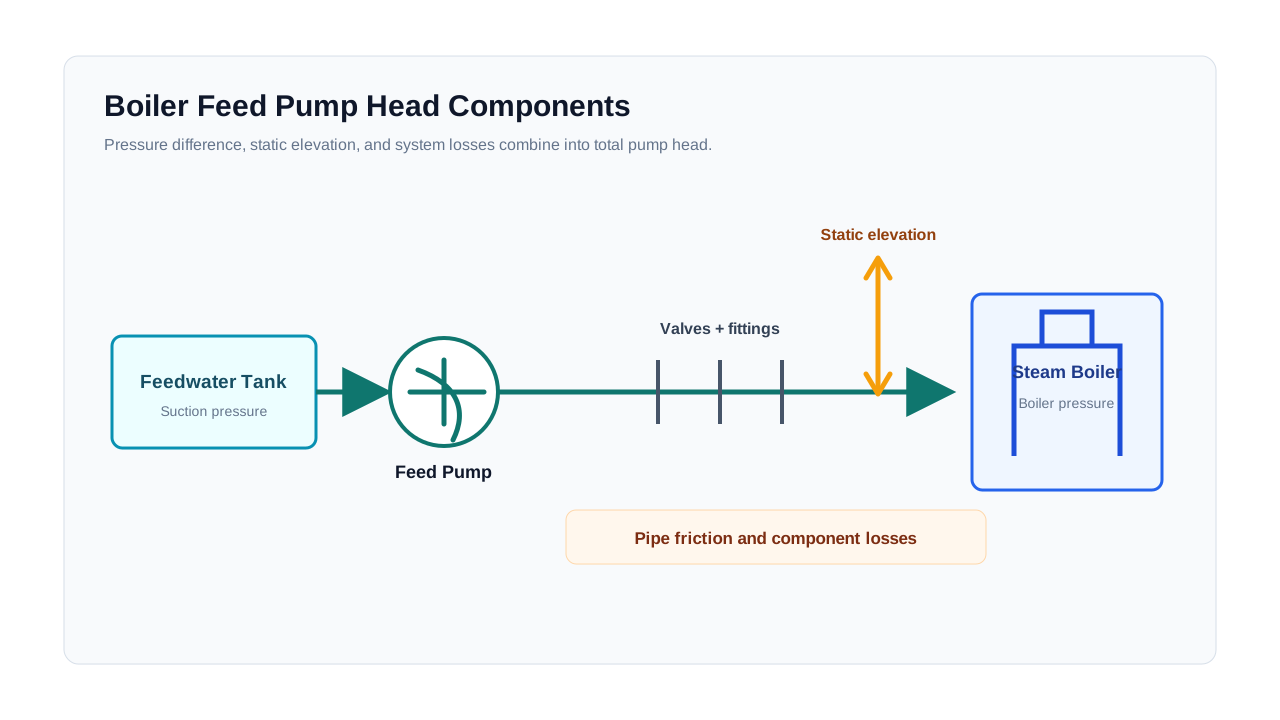
Boiler feed pump head components including pressure, static head, and system losses
Boiler feed pump head combines pressure difference, static elevation, and system resistance.

Pump head represents the energy added by the pump to the fluid and is commonly expressed in meters of fluid or feet of fluid.

For a boiler feed pump, the required head must overcome boiler pressure, elevation differences, pipe and fitting losses, valves and restrictions, and enough operating margin for the intended duty.

The complete requirement is commonly represented as total dynamic head, or TDH.

  • Boiler pressure
  • Elevation difference
  • Pipe and fitting losses
  • Valve restrictions
  • Design margin

What Is Total Dynamic Head?

Each TDH component represents a different part of the resistance that the pump must overcome.

Pressure head is the energy required to overcome a pressure difference. Static head is the elevation difference between suction and discharge reference points. System losses include friction and resistance from pipes, valves, fittings, filters, check valves, and control valves.

A practical design process may include a margin for uncertainty and operating variation, but that margin should be based on the application rather than an arbitrary oversized percentage.

Formula

TDH = Pressure Head + Static Head + System Losses + Design Margin

Step 1 Determine the Pressure Head

Pressure head converts a pressure difference into an equivalent fluid head. H is pressure head in meters, Delta P is pressure difference in pascals, rho is fluid density in kg/m3, and g is gravitational acceleration, approximately 9.81 m/s2.

For example, 10 bar equals 1,000,000 Pa. For water at about 1,000 kg/m3, the pressure head is 1,000,000 / (1,000 x 9.81), or approximately 101.9 m.

The actual calculation should use the appropriate fluid density and the actual pressure difference across the pump.

Formula

H = Delta P / (rho x g)

Gauge Pressure vs Absolute Pressure

Boiler pressure may be reported as gauge pressure, absolute pressure, or pressure relative to another system pressure.

Head calculations should be based on the actual pressure difference the pump must overcome, not simply a pressure value copied from a gauge without considering the reference pressure.

If the pump suction already has significant pressure, the relevant quantity is the difference between discharge-side and suction-side pressure.

Related suction guide - NPSH in Boiler Feed Pump Sizing

Step 2 Determine the Static Head

Static head is the elevation component of the system. It represents the vertical difference between the relevant fluid levels or delivery points.

For example, if the boiler connection is 12 m above the pump suction reference point, the static component is approximately 12 m.

Static head does not depend directly on pipe length, although long pipe runs can still increase total pump head because they introduce friction losses.

Formula

Static Head = Elevation at Discharge - Elevation at Suction

Step 3 Calculate Pipe and Fitting Losses

A boiler feedwater system can contain many sources of hydraulic resistance, including straight pipe, elbows, tees, valves, check valves, filters, control valves, reducers, and other fittings.

These losses are part of the dynamic component of pump head. Flow velocity, pipe diameter, internal surface characteristics, fluid properties, and component geometry all influence the final loss.

For detailed system design, individual losses should be calculated using an appropriate hydraulic method and manufacturer data where available.

Step 4 Determine the Total System Head

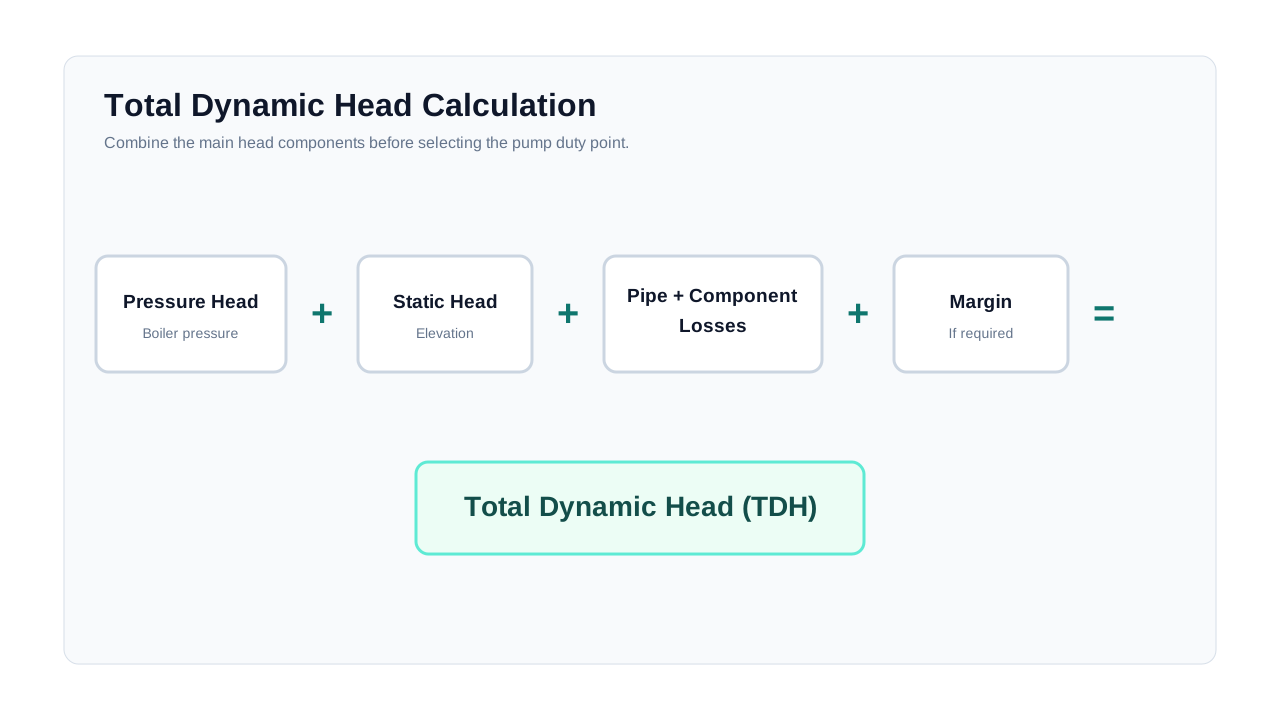
Total dynamic head calculation for a boiler feed pump
TDH adds the pressure, elevation, friction, component losses, and any appropriate design margin.

Once the individual components are known, combine them to estimate the preliminary total dynamic head.

For example, if pressure head is 102 m, static head is 12 m, and pipe and component losses are 16 m, then TDH = 102 + 12 + 16 = 130 m.

If the design process calls for an additional margin, that margin should be considered based on the application actual requirements.

Formula

TDH = Pressure Head + Static Head + System Losses + Margin

Why Boiler Pressure Is Only One Part of Pump Head

Boiler pressure can be a major contributor to feed pump head, but it does not necessarily represent the entire pump requirement.

The pump may also have to overcome elevation, piping losses, valve losses, control equipment, filters, and other restrictions.

The required pump duty must account for the complete system rather than assuming boiler pressure alone defines the pump head.

Step 5 Consider the Pump Duty Point

Pump head should always be evaluated together with flow rate. For example, 25 m3/h at 130 m head is a flow-head duty point.

A pump that can produce 130 m head at a very low flow may not be suitable if the system requires 25 m3/h. Likewise, a pump capable of 25 m3/h at a much lower head may not overcome actual system resistance.

The manufacturer pump performance curve should be checked to confirm that the selected pump can deliver the required flow at the calculated head.

Next calculation - How to Calculate Boiler Feed Pump Power

How Head Calculation Fits Into Boiler Feed Pump Sizing

Head calculation is one part of the overall pump-sizing process. The complete process typically moves from feedwater flow to pump head, duty point, power, motor, NPSH, and pump curve review.

For a broader explanation of the complete process, see How to Size a Boiler Feed Pump.

Once the flow and head are established, power, motor sizing, efficiency, and NPSH can be evaluated before final pump selection.

Read the complete sizing guide - How to Size a Boiler Feed Pump

Common Mistakes

  • Using boiler pressure as the entire pump head
  • Ignoring pump suction pressure
  • Ignoring pipe losses
  • Confusing pressure with head
  • Using the wrong pipe conditions
  • Selecting a pump based only on head
  • Adding an arbitrary large safety margin

Related Boiler Feed Pump Guides